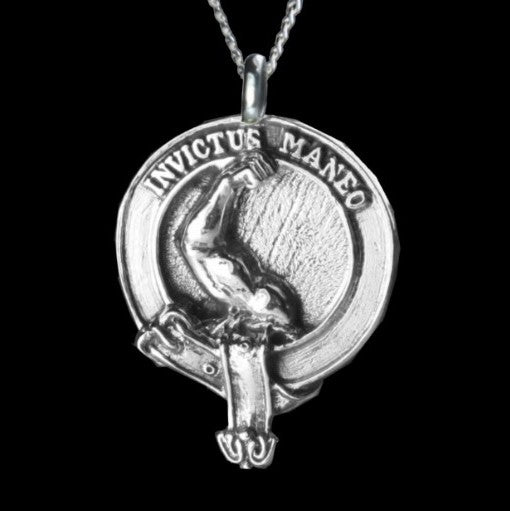
ARMSTRONG CLAN
Armstrong pendant

Scottish Clan crest pendant for Armstrong family surname  - matches ladies crest ring 


Price: US$58.00

http://www.scotjewelry.com/1253-thickbox/armstrong-clan-crest-pendant-scottish-ring-family-surname-invictus-maneo.jpg
Armstrong pendant

This Armstrong Crest shown above has been a symbol of your Scottish Clan heritage for centuries. 

Ladies celebrate your Armstrong Clan ancestry with this finely sculptured Scottish clan pendant designed in size to match the Armstrong lady's Celtic sided crest ring. This Scottish pendant carries the Crest of a strong right arm and the proud Armstrong clan motto " Invictus Maneo" which means (I remain unvanquished).

Delivery: As we make this pendant to your order, please allow two weeks for production, and a week to most shipping destinations.     This Armstrong pendant is available in solid sterling silver or gold - matching chains 20" (45cm) are also available to purchase.

Click each row of boxes below to view all crest items:            See your Armstrong Family History below.

ARMSTRONG CLAN History
ARMSTRONG CLAN


Clan Armstrong:  No Clan Chief currently exists.

Last Chief:          Archibald Armstrong of Mangerton Died about 1610

Gaelic Name:        Mac Ghillielaidir

Origin of name:   It is said to come from Siward Digry (“sword strong arm”),

                         a nephew of the Danish King Canute.

Crest Badge:        A Strong right arm.

Clan Motto:         Invictus maneo (I remain unvanquished)

Lands:                Liddesdale


The Armstrong Clan Crest is of a strong right arm and the bold Armstrong clan motto reads "Invictus maneo" meaning in Latin "I remain unvanquished".

Clan Armstrong are renowned as one of the most powerful families in the turbulent Border regions of Scotland. The Armstrong surname is first recorded in 1235 when Adam Armstrong was pardoned at Carlisle for causing the death of another man.

The Armstrongs descend from Fairbairn, who held the position of armourer to an ancient King of Scotland. The legend of Fairbairn’s loyalty recounts that when the King became dismounted during the heat of battle, Fairbairn scooped the fallen sovereign up onto his own horse with a single stroke of his well-muscled arm. In gratitude to Fairbairn’s gallant service, the King named him Armstrong and granted his family the lands of Mangerston in Liddlesdale. True to their name, the Clan’s strength grew quickly, and the Armstrongs soon assumed further lands in Annandale and Eskdale.

Like many Border Clans, the Armstrongs were a law unto themselves and dictated the course of their own lives, free from the shackles of any overlord.

The location of the Clan’s territories meant that Scotland’s Kings were unable to effectively control such a fierce and unruly Clan as the Armstrongs. The Armstrongs began to amass their fortune by cross-border raiding, regularly skirmishing into England to steal the sheep and possessions of less bold men. Indeed, the strength of the Armstrongs was such that they were said to be able to put over three thousand horsemen into the field by the year 1528.

The Crown occasionally attempted to control the Armstrongs, but the notoriety of the Clan was such that even kings used subterfuge to gain their will. In 1530, James V betrayed all the ancient codes of honour when he seized the chieftain Johnnie Armstrong and 36 of his horsemen, as the unarmed Johnnie welcomed the King to stay at his castle. The Armstrongs virtually ruled the Borders through right of the sword, and this had caused the ire of the young monarch. As James V strung up the 37 men, Johnnie stated his own epitaph "I was but a fool to seek grace at a graceless face, but had I known you would have taken me this day, I would have lived in the borders despite King Harry [King Henry VIII of England] and you both." Such was the Armstrongs' disgust at the King’s treachery, that they refused to support the Scottish Crown when Henry VIII invaded Scotland in 1542. When another Armstrong, Kinmont Willie, was imprisoned during a time of truce, a hand-picked team of 40 defiant horsemen stormed the castle and secured his release. The last Chief, Archie Armstrong, was executed as an outlaw in 1610, and the lands of Mangerston were forfeited to the rival Clan Scott.

On the 21st of July 1969 Neil Armstrong was famously known as the first man to walk on the Moon and carried with him a fragment of his Armstrong tartan.


The Armstrong Clan Crest is of a strong right arm and the bold Armstrong clan motto reads "Invictus maneo" meaning in Latin "I remain unvanquished".


Our Scottish Heritage is the common bond that unites our Armstrong family name forever.........  

An old Gaelic proverb................  ‘Remember the men from whence you came’   

 Robert Louis Stevenson wrote....

"The mark of a Scot of all classes is that he remembers and cherishes the memories of his forebears, good or bad, and here burns above in him a sense of identity with the dead even to the twentieth generation."


There are several spelling variations for the Clan Armstrong surname. Included are families (known as Septs) with different surnames from the original Clan name. Throughout the centuries, surnames have continued to “develop” often leading to astonishing variants of the original spelling. 


Septs/Spelling Variations of ARMSTRONG CLAN
CROSIER of ARMSTRONG CLAN    CROZIER of ARMSTRONG CLAN    FAIRBAIRN of ARMSTRONG CLAN    GROZIER of ARMSTRONG CLAN   
What our customers say