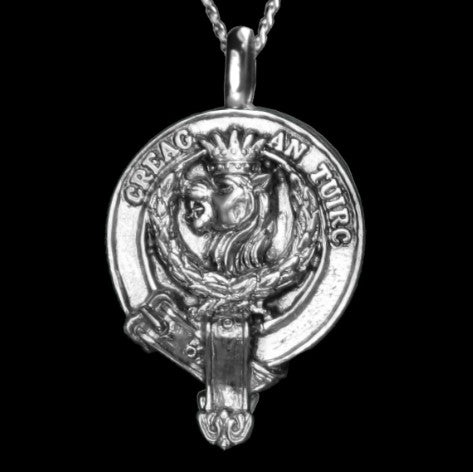
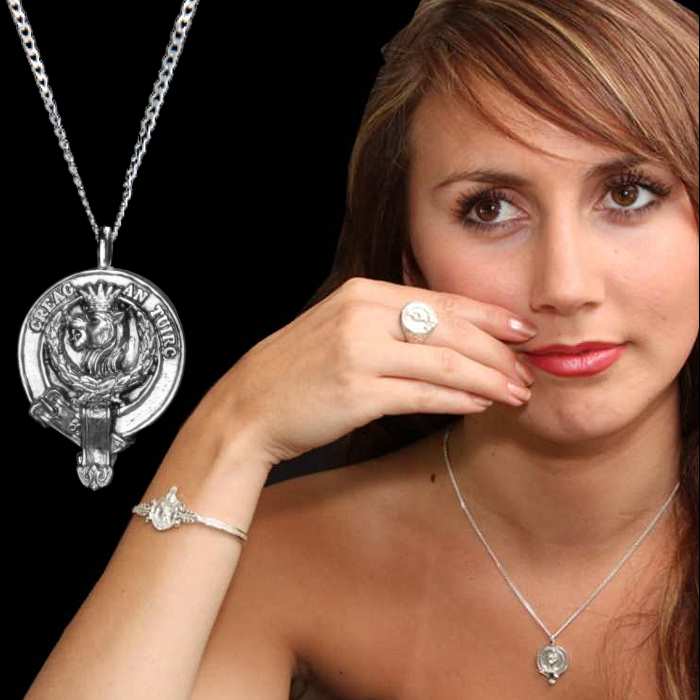
MacLaren family pendant – size matches lady’s crest ring
Sterling silver pendant starting from US$58
MacLaren family pendant – size matches lady’s crest ring
Sterling silver pendant starting from US$58
For centuries this MacLaren Crest has been a symbol of your Scottish Family unity - see your MacLaren Family History below.
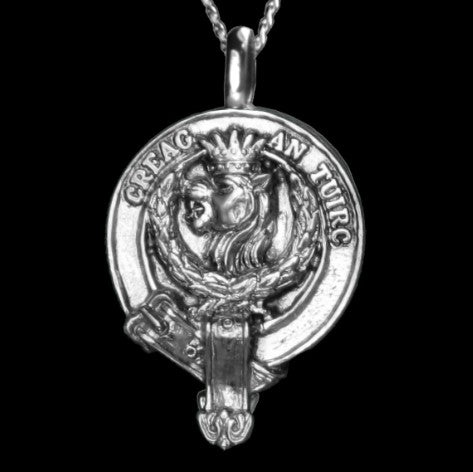
Ladies celebrate your MacLaren clan heritage with this finely sculptured Scottish pendant, designed in size to match the MacLaren lady's Celtic sided crest ring. This Scottish pendant carries a lion’s head wearing an antique crown between two branches of laurel from a wreath at either side and the proud MacLaren clan motto, “Creag an tuirc" meaning (The boar's rock).
Delivery: As we make this pendant to your order, please allow two weeks for production, and about a week to most shipping destinations. If you require your jewelry item more urgently, please let us know.
This MacLaren pendant is available in solid sterling silver or gold - matching chains 20" (45cm) are also available to purchase.
"Remember the people from whence you came"
The MacLaren Clan Crest is a lion’s head wearing an antique crown between two branches of laurel from a wreath at either side and the proud MacLaren motto and rallying cry is "Creag-an-Tuirc" which means 'The Boars Rock', a prominent landmark of their homelands.
The Kingdom of the Scots was established by Erc who landed in Argyll in 503A.D. and it is from his son and successor, Loarn, that the Mclarens, like their kinsmen the Earls of Strathearn, are descended. The homeland of the Clan is centred in the picturesque village of Balquhidder on the banks of loch Voil, to the east of Loch Lomond. That the Mclarens were regarded as a very warlike clan was understandable. Their lands surrounded by the avaricious Campbells and the wild and lawless MacGregors, the Mclarens had to be warriors in order to survive and hold their lands.
In one incident in 1558, the MacGregors of Glendochart surprised the Clan and massacred 18 Mclaren households at Balquhidder. The constant defence of their lands developed a military nature and by the 15th century many Clansmen became soldiers of fortune in the armies of European monarchs. In the 17th century, many Mclarens joined the army of the King of Sweden and helped him in his great successes against the Germans and Austrians. For their services on the battlefields, a number of the Clan were granted lands in Sweden and ennobled there. Colonel 'Johan Laurin' (the Swedish spelling), became Provost of East Gotland in Sweden and was created Baron Lagergren and died in 1673. Another 'John Lauren' became a Swedish baron in 1678 and 'Magnus Laurin' became Count Lagerstrome in 1691.
The Clan also took part in the wars of Scotland in support of the Stuart Kings and in the Jacobite uprisings of 1715 and 1745, suffering badly in the Battle of Culloden. After this battle their leader, Donald of Invernenty was captured but made a dramatic escape before reaching England. Sir Walter Scott wrote of this incident in his novel 'Redgauntlet' Not all of the Clan's achievements were in the military field.
The remarkable Colin MacLaurin, who was born in 1698, entered Glasgow University when he was 12 years old and became Professor of Mathematics at Marischal College aged 19 and when 27 years old became Professor of Mathematics at Edinburgh University. The Clan has also produced Members of Parliament and Judges and at least one British Baron. A group of MacLaurins (another spelling of the name) who emigrated to North Carolina in 1789 founded the town of Laurinburg.
Donald MacLaren of MacLaren and Achleskine is the current Clan Chief.