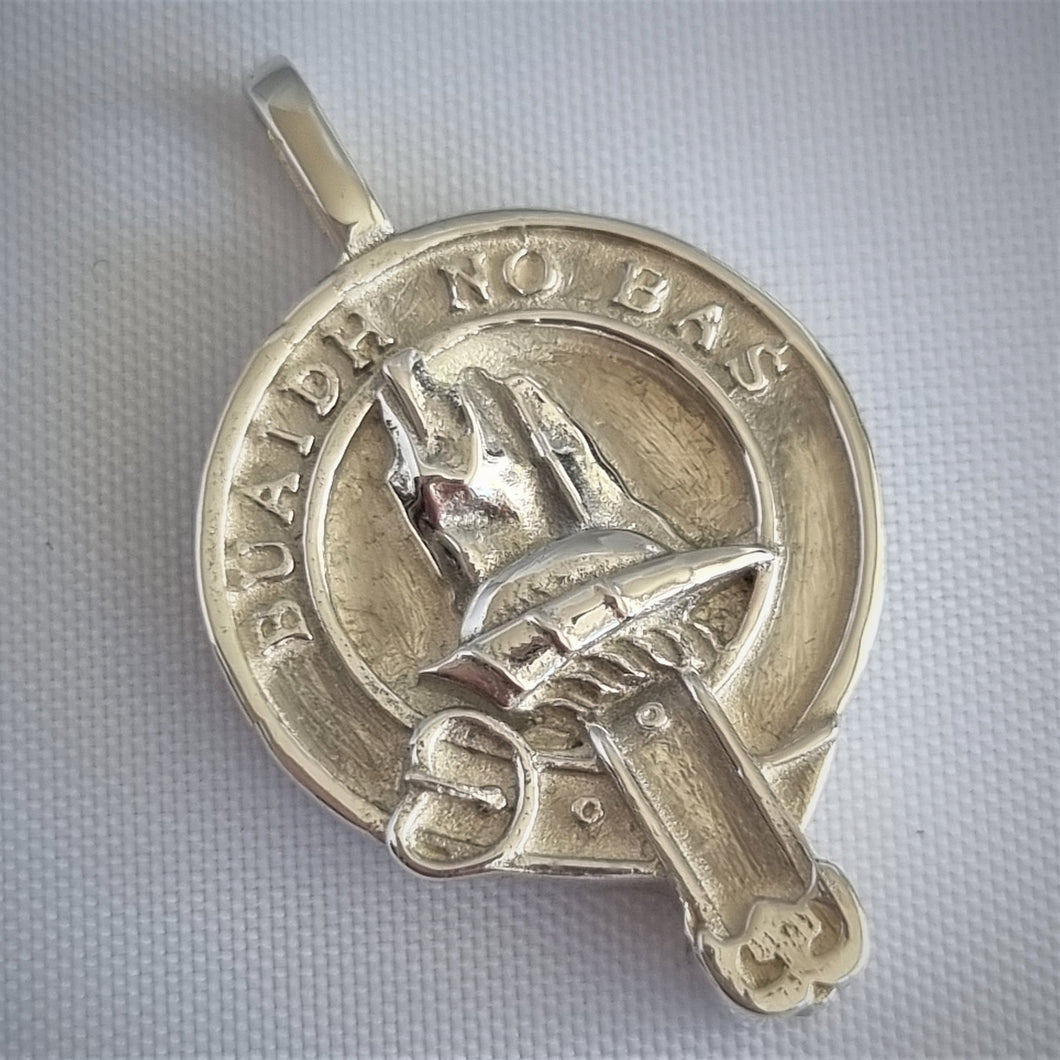
MacNeil family pendant – size matches lady’s crest ring
Sterling silver pendant starting from US$58
MacNeil family pendant – size matches lady’s crest ring
Sterling silver pendant starting from US$58
For centuries this MacNeil Crest has been a symbol of your Scottish Family unity - see your MacNeil Family History below.
Ladies celebrate your MacNeil clan heritage with this finely sculptured Scottish pendant, designed in size to match the MacNeil lady's Celtic sided crest ring. This Scottish pendant carries a rock rising from a velvet cap and the proud MacNeil clan motto, “Vincere vel mort” - can also be shown as “Buaidh no bas” (To conquer or die).
Delivery: As we make this pendant to your order, please allow two weeks for production, and about a week to most shipping destinations. If you require your jewelry item more urgently, please let us know.
This MacNeil pendant is available in solid sterling silver or gold - matching chains 20" (45cm) are also available to purchase.
"Remember the people from whence you came"
The MacNeil Clan Crest is a rock rising from a velvet cap and the proud MacNeil clan motto boldly states, “Vincere vel mort” meaning (To conquer or die).
Clan MacNeil, standing proud as one of the fiercest of all island clans, claim descent from Niall, grandson of the king of Ireland, who settled the Outer Hebrides island of Barra in the mid 11th Century. According to MacNeil tradition, however, the origins are somewhat earlier. There is a famous story, known throughout Scotland, of the MacNeil chief being offered a place on Noah's Ark, only to decline by succinctly stating that the great MacNeil had their own boat! However, the Clan's strength of unity was no mere fable.
The MacNeil Chiefs are notable in Scottish history for the caring treatment of the members of the Clan - taking the impoverished elderly into their own household, replacing the cattle of crofters when fortunes deprived them of their stock, and even finding widowed Clan members new partners. This sense of pride, stemming from the proud legacy of the Clan MacNeil, ensured that they stood firm in the face of any hostility, and quickly earned its reputation as a turbulent Clan.
The warlike nature of the MacNeils is exemplified in one early 17th Century Chief, Ruari the Tatar (or Turbulent), being regarded as the last of the Vikings after habitually conducting longship raids from the Barra Castle of Kisimul. This "hereditary outlaw" led King James VI to order that the fierce Clan MacNeil be destroyed, root and stem, in 1610. Few, however, were up to this job, and with characteristic loyalty to the King, the MacNeils themselves captured Ruari, placed him in chains, and delivered him to the King. This innate sense of fealty to the Crown of Scotland have led the MacNeils to be an honoured clan in the volumes of Scottish history.
MacNeils have fought in many of Scotland's battles, from the famous Battle of Bannockburn in 1314 (for which the MacNeils received lands in Kintyre by way of reward), to supporting the Stuart monarchs in the Civil War, and the Jacobite Rising of 1715. The MacNeils' efforts did not go unrewarded, with the MacNeil Chiefs receiving a Crown charter erecting all the lands of Barra into a free barony in August 1688. The Clan seat on the island of Barra was bought back by the MacNeils in 1937, after being alienated for almost a century, & the ancient Kisimul Castle restored.
The 26th Chief, a Professor of Law, is Ian R. MacNeil of Barra.