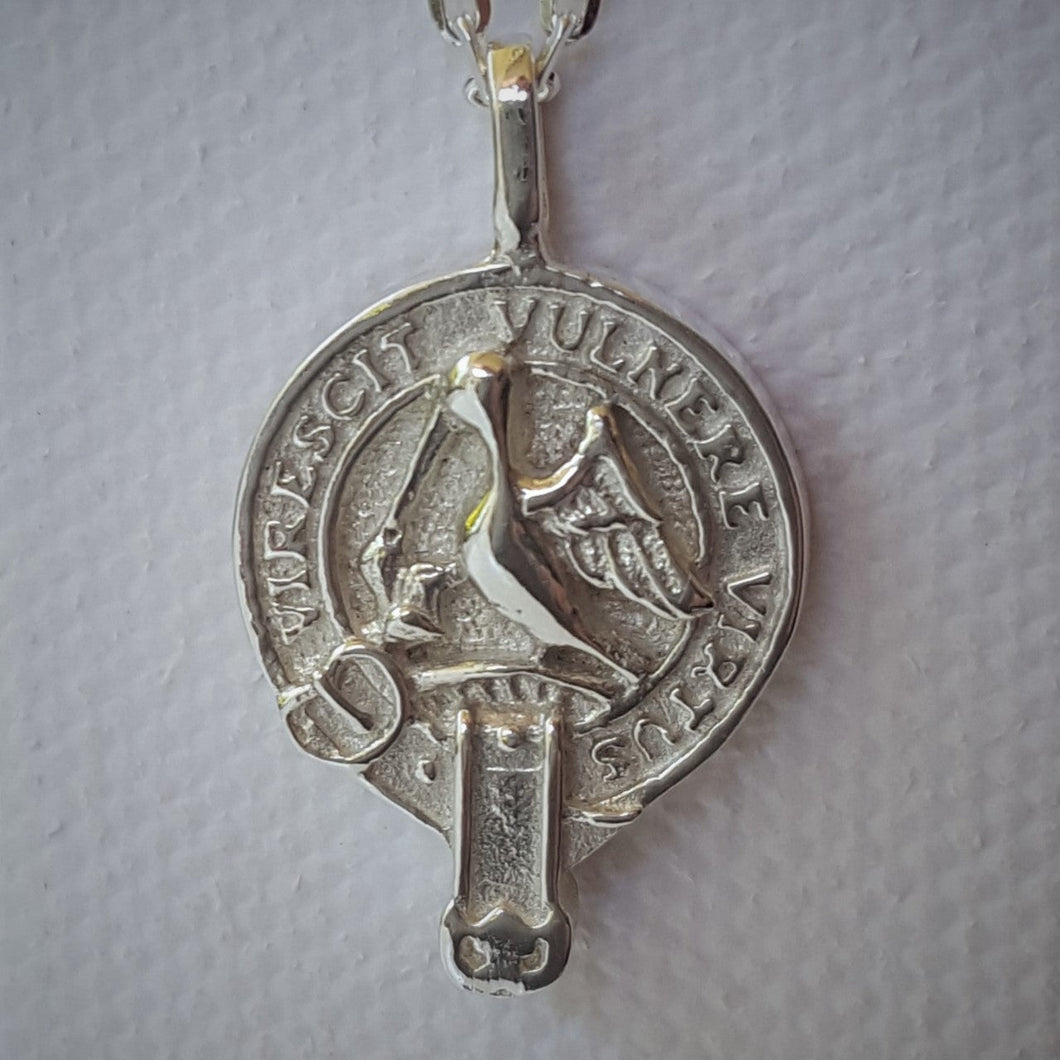
Scottish Clan crest pendant for Stewart family surname - size matches the ladies crest ring
This Stewart Crest shown above has been a symbol of your Scottish Clan heritage for centuries.
Ladies celebrate your Stewart Clan ancestry with this finely sculptured clan crest pendant designed in size to match the Stewart lady's Celtic sided crest ring.This Stewart crest carries a pelican in her nest feeding her young, and the proud Stewart clan motto, “Virescit vulnere virtus” meaning (Courage grows strong at a wound).
This Scottish pendant is available in solid sterling silver or gold - matching chains 20" (45cm) are also available to purchase.
Delivery: As we make this pendant to your order, please allow two weeks for production, and about a week to most shipping destinations. If you require your jewelry item more urgently, please let us know.
Click each row of boxes below to view all crest items: See your Stewart Family History below.
"Remember the people from whence you came"
The Stewart Crest carries a pelican in her nest feeding her young, and the proud Stewart clan motto, “Virescit vulnere virtus” meaning (Courage grows strong at a wound).
The Stewarts, Scotland's most noble Clan, have always played a pivotal role in the history of Scotland. The Clan is descended from Walter FitzAlan, son of an Anglo-Norman baron, who was appointed High Steward of the royal household by his friend King David I of Scotland, and was also granted tracts of land in Renfrew, Cathcart, Pollock and Paisley. Later, under King Malcolm IV, the office of High Steward was made an hereditary title, and the Clan Chief became known as "the Steward", the title giving rise to the Clan name of Stewart.
Walter, the 6th Steward commanded, at the age of twenty one, the centre of the victorious Scottish army at the Battle of Bannockburn in 1314. His loyalty and courage were well rewarded when Walter gained the hand of Marjorie, the daughter of King Robert the Bruce, in marriage. Their son became King Robert II - the beginning of a royal Stewart Dynasty that was to last several centuries. When Mary, Queen of Scots married the Dauphin of France the name was spelled Stuart to accommodate the French tongue. Her son, James VI, became James I of England, uniting the Crowns of both Scotland and England under a single Stewart sovereign.
The Clan was active in most of Scotland's wars. A great number of the Clansmen were killed at the final Battle of Culloden fighting for that charismatic but ill fated leader, Charles Edward Stuart, - Bonnie Prince Charlie. The House of Stewart not only provided all of Scotland's monarchs from 1371 to 1603, and of the United Crowns of Scotland and England from 1603 to 1714, but held through time, 13 Dukedoms and 17 Earldoms in Great Britain. Stewarts also provided two British Prime Ministers, and the House of Stewart held Dukedoms in Italy, France and Spain. Although the Royal Stewart tartan is worn by H.R.H. Queen Elizabeth II, the Chief of the Stewarts is Sir Randolph Stewart, 13th Earl of Galloway.
The Clan has developed several branches, including Stewart of Appin, Stewart of Atholl, and Stuart of Bute, all of these descending from a common Stewart origin. The old Gaelic word "Clan" means "The Children of" or "Family" and although the Clan is now spread throughout the world, all should be aware of their roots and, in the words of the old Gaelic proverb, - "Remember the People from whence you came".